Thursday, October 22, 2009

French without faux pas: rules for the office


So you thought Gallic style was effortless? Far from it, as a new guide to the complexities of office life reveals
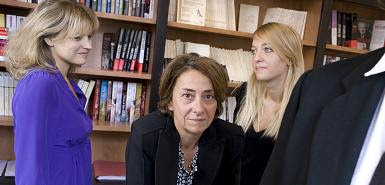


Want to work in France? Then you will need to mind your language and the way you look. Your hair, clothes and make-up must be immaculate, even after a long, hard day. Your self-control should be total and your conversation will avoid all subjects likely to rile colleagues, such as love, money and your personal problems.

This advice on the Gallic ideal comes from the author Laurence Caracalla, who has written a guide to French office life that covers such subjects as clothes, manners, parties and romances. It makes daunting reading.

At 7pm, for instance, a self-respecting Frenchwoman must look and sound as fresh as if she had just showered in the morning, Caracalla says. Her appearance will be flawless, her conduct exemplary.

Smiling and fragrant, her ideal office worker will feign interest in the boss’s account of his marital woes but not bother him with his or her own — and will then text a lover and arrange to meet at a suitably tactful distance from the office.

The key, according to Caracalla, is a combination of discipline and education. For the French, in her view, are not effortlessly chic at all. On the contrary, the effort required of them is gruelling.

Caracalla, 47, is a former Paris press officer who apparently spent much of her early working life correcting les fautes de goût — errors of taste — made by those around her. An un-ironed shirt? An upturned collar? Cheap perfume? Whatever the error, it had to be corrected.

Two years ago she decided to condense into book form all the advice she had been offering to friends, family and colleagues.Le Carnet du Savoir-Vivre (The Notebook on Manners) was an instant success and Caracalla became a sort of national arbiter on social etiquette.

Should a male host greet female guests with a kiss? (Yes, if he knows them already). What should you talk about at a dinner party? (Films, art exhibitions but not your last holiday, your health or your children’s school results). How often should you have your feet done at the beauty parlour? (At least once a year).

These questions were obviously preying on the Gallic mind, as Caracalla is now asked to expand on them regularly for talk shows and is soon to start a blog on the subject for Le Figaro.

In her view, the unwritten rules of office life are a labyrinth in which even French employees can easily get lost — so this summer she followed up her first success with Le Carnet du Savoir-Vivre au Bureau (The Notebook on Office Manners).

Her bestseller runs to 248 pages of tips for anyone planning to work in France. Don’t eat roast snails the day before an important meeting, for example — your breath will smell of the garlic they are cooked in. Always remember to say “Bonjour” to others in the company lift — they will take offence if you look in silence at your shoes, which, by the way, must be polished daily. And never ever mention your salary, the cost of your watch or the size of the restaurant bill that you are offering to pay — money in 21st-century France is like sex in 19th-century Britain, the great taboo. It is better to phone the restaurant afterwards to complain that the waiter has overcharged you.

In person, Caracalla looks the part. Her make-up respects her own golden rule, that “it must light up your face without others really knowing where the brilliance comes from”. Her elegant black jacket and chiffon blouse are similarly immaculate and her smartly sandalled feet have obviously been taken for their regular visits to the beautician.

She assures me that she still does her best to preach what she practises — a point underlined when her press officer appears with a slightly upturned collar. “Your collar,” she says. He flattens it down swiftly.

Her protocols apply at least as much to behaviour as to appearance. Take, for example, the end-of-year party (which is, anyway, a far more sober affair in France than in Britain). Caracalla warns her readers sternly not to let their hair down or even to be seen with someone who has let his or her hair down.

“Be yourself, just smile a little bit more than usual and be a little bit more affable,” she counsels. “Flee the colleague who seems tipsy like the plague.”

You may have thought of the French as a nation dedicated to the good things in life. But in Caracalla’s view fun doesn’t really enter the equation, at least not in the workplace — not at the office party, not on your coffee break and certainly not during a business lunch.

Fancy wine with the meal? “Be careful. Alcohol makes you lose your inhibitions and you may disclose confidential things and regret it bitterly,” says Caracalla. If your guests want a bottle of red, allow yourself a glass. Otherwise, make sure you stick to water.

The same self-control is necessary if you spot an acquaintance on the other side of the restaurant. “Stop yourself from waving ... a simple smile or a small gesture with the hand will do.”

Want to break the ice with a joke? Bad idea. “You can’t tell if you’re going to be funny. The best thing is to abstain.”

Spontaneous office chatter is banned. “Turn your tongue seven times in your mouth before speaking” is an old French expression that sums up the Caracalla approach perfectly.

Dying to tell colleagues about your daughter’s appendicitis? About your nightmare journey home last night? About your visit to the dentist? Caracalla winces. “We are always convinced that our lives are enormously interesting,” she says, “but you have to get it into your head that you probably don’t interest other people that much at all.”

This advice applies particularly in open-plan offices, where extreme caution must be exercised. “Remember what you were always told as a child,” says Caracalla. “Don’t bother other people. Don’t speak too loudly.”

So no laughter, no whoops of delight, no barking into the telephone and no “bling” jewellery that may bang against your desk.And while we are on the subject of objectionable habits, avoid an overdose of perfume “which can purely and simply ruin the life of your colleagues”.

How much perfume is too much? “A few drops behind the ears and on the coat in winter are enough,” says Caracalla.

But what if you have fallen in love with an accountant on the third floor? Surely you can then cast aside the rules and splash on perfume in the name of l’amour ? This, after all, is supposed to be a nation with a romantic pulse.

Again, the answer is no. Strict as ever, Caracalla says that office affairs must be hidden: steer clear of contact at work, meet only outside the office, never reveal your feelings to third parties.

Best of all, she says, avoid office affairs altogether, as most of them end in tears. “Every day you will come across the object of your torment. It is depressing,” she says. “If an affair does happen, avoid making a scene in front of witnesses. That will embarrass everyone and you will be a laughing stock.”

So, is there any solution for the love-struck French office worker? Here’s a thought. Move to Britain. It may not be so chic. Your colleagues may be less well-dressed and they may not behave with such decorum — but at least you can drown your sorrows in the pub opposite when the accountant on the third floor dumps you in favour of his secretary.


http://women.timesonline.co.uk/tol/life_and_style/women/the_way_we_live/article6884482.ece

Ida, the fossil hailed as ancestor of man, 'wasn't even a close relative'


IT WAS billed as one of the most important fossil finds in history, a "missing link" that would challenge everything we knew about human evolution.

Darwinius masillae, the primitive primate that was unveiled to the world with huge fanfare and a Sir David Attenborough documentary in May, seems now to have been less of a missing link than an evolutionary dead end. Far from being an ancestor to humans, the lemur-like creature from 47 million years ago belongs to an entirely different branch of the primate family tree that has left no known descendants, research has indicated.

When Jorn Hurum, of the University of Oslo Natural History Museum, announced the discovery of the astonishingly well-preserved fossil, he described it as "the first link to all humans". He nicknamed the animal "Ida" after his daughter, and a promotional website, a film and a book claimed that she could have been the common ancestor of all modern monkeys and apes, a relic of a critical branching moment in human evolution. Sir David, who narrated the documentary, said: "This little creature is going to show us our connection with the rest of all mammals. The link they would have said until now is missing, is no longer missing."

The discovery of fossils of another similar animal from 37 million years ago has now cast grave doubt on that idea. Both Darwinius masillae and the new primate, Afradapis longicristatus, appear to belong to a different lineage, closer to lemurs than monkeys and apes, that died out without modern descendants.

A major analysis of 117 living and extinct primates found that neither new fossil belongs on the evolutionary path that led to the anthropoids - higher primates such as monkeys, apes and humans.

Erik Seiffert, of Stony Brook University in New York state, who led the study, said: "Our analysis provides no support for the claim that Darwinius is a link in the origin of higher primates, and instead indicates that, if anything, Darwinius is more relevant for our understanding of the origin of lemurs and lorises - which are our most distant primate relatives."

The findings, published in the journal Nature, will reignite controversy over the Darwinius fossil. While it sheds important light on primate evolution, the bold claims about its position as an ancestor to humans surprised many palaeontologists, who felt that the PR hype was not justified by the evidence. Critics said that Darwinius appeared to be an adapid - an extinct group more closely related to modern lemurs than to anthropoids.

There was also widespread dismay at Dr Hurum's decision to sell film and book rights to the discovery before it had been published in a peer-reviewed journal. That meant that his controversial interpretation was presented to the public before it had been tested by the scientific community.

The new fossils, the first of which were found by Dr Seiffert's team in Egypt in 2001, indicate strongly that this interpretation was indeed wrong. While Afradapis longicristatus and Darwinius have some anatomical features similar to anthropoids, Dr Seiffert's research shows that these must have evolved independently.

"We compiled a large dataset of anatomical observations, made across 117 living and extinct primates, including all of the fossil primates that have been proposed as possible early members of the anthropoid group," Dr Seiffert said.

"We used a computer program to find the primate family tree that provides the simplest explanation for the distribution of these traits. In that tree, adapiform primates like Darwinius and Afradapis are not placed close to higher primates, but rather are situated as closer relatives of the living lemurs and lorises."

Dr Seiffert said: "The PR hype surrounding the Darwinius description was very confusing. The uninformed observer watching the associated documentary certainly must have come away with a very different view - specifically that Darwinius truly was a critically important link in the origin of higher primates, if not the origin of apes or even humans.

"Documentaries are extremely important for public understanding of science, so scientists and the media need to work together to make sure that they have their facts straight, and that they are portraying a balanced view of the evidence. I think that the most responsible approach would be to create documentaries well after publication of scientific results."

http://www.theaustralian.news.com.au/story/0,25197,26244567-2703,00.html

Meet Emily Howell, classical music's virtual composer


EMILY HOWELL could be the next big hit in the classical music world. She has already received critical acclaim for her compositions and secured a record deal, with her debut album due for release next year.

Emily Howell, however, is a computer program. The brains behind her music belong to David Cope, a music professor at the University of California, Santa Cruz. After almost four decades' work he has created a machine that can create original compositions of contemporary classical music.

One commentator said that Emily Howell's "modern masterpieces make her among the most technically unique composers in America".

Her first album, From Darkness, Light, is due for release in spring. It is played by humans on two pianos through six movements.

Professor Cope said that he initially created programs that could analyse the work of hundreds of classical composers such as Mozart and Beethoven, and replicate their style. "I was successful in creating a bad program that would create bad music," he said. "It was drivel."

The system improved over time, but eventually Professor Cope moved on to create something that could not only imitate others, but also create original pieces in a style of its own.

"I put my skills into creating a unique composer that created contemporary classical music that would be interesting and grab people's attention, but was in nobody's style except that particular kind of software."

Professor Cope said the music from Emily Howell's album was similar to that of 20th-century composers such as Stravinsky, but fundamentally different in style.

The project has been controversial. Many have urged him to "kill" Emily Howell, saying that the program was against the innate human spirit of music creation. Some composers and orchestras have refused to play her work. Although eventually a number of big-name classical performers expressed interest in playing the music, their agents would not let them, citing industry controversy over the work.

Professor Cope believes that it is reaction to the idea of computer-created compositions, rather than the music itself, that causes people to dislike it. He pointed to the example of the first concert of the work, which was played at his university a year ago, when the audience was not told that Emily Howell was a computer program.

"A professor came to me and said this was one of the most beautiful pieces he'd heard in a long time. The first concert was received extremely well.

"Then I lectured about the program, and presented From Darkness, Light again. The same professor came back and said, 'From the minute it started I could tell it was computer-composed. It has no emotion, no guts, no soul.' He had not remembered the music from the previous concert, and would not believe it was the same music.

"Those people who have a belief that computer programs can't compose music will believe that, and supersede their personal taste."

But many experts remained sceptical about the project. "For me, music is primarily about the human condition," said Hilary Finch, a classical music critic. "A machine is doing something different. I'm not sure how satisfying it could be to humans."

Professor Cope argues that Emily Howell's music is the distillation of the work of the great composers of the past and present. "Computers are not separate things," he said. "The computer is human-made. The program itself is human-made. The music in the database is human as well. There's so much about this that is human. There's just a lot more humans involved in making this than usual."

http://www.theaustralian.news.com.au/story/0,25197,26244626-2703,00.html

Thursday, October 15, 2009

Christopher Columbus writings prove he was Spanish, claims study


Italy, France, Portugal and even Scotland are among those who have claimed Christopher Columbus as their own over the years, citing a range of spurious links.

But American researchers say the mystery over the explorer's true origins has finally been solved after a thorough investigation of his writings.

A study of the language used in the official records and letters of the Great Navigator apparently proves he hailed from the Kingdom of Aragon in northeastern Spain and his mother tongue was Catalan.

Since his death in 1506 debate has raged over the true nationality of the man credited with discovering the Americas.

It was widely believed that he was the son of a weaver born in the Italian port of Genoa, but over the centuries he has been claimed as a native son of Greece, Catalonia, Portugal, Corsica, France and even Poland.

According to one theory, he may have been Jewish and another more recent account traced his origins to Scotland.

But a linguistic professor at Georgetown University in Washington has published new findings following an exhaustive study of documents written in his hand.

Estelle Irizarry studied his language and grammar and concluded that Columbus was a Catalan speaking man from the Kingdom of Aragon, an inland region of north-eastern Spain at the foot of the Pyrenees.

The findings published this month in a new book "The DNA of the writings of Columbus" explain that although he wrote in Castilian it was clearly not his first language and his origins can be pinpointed to the Aragon region because of the grammar and the way he constructed sentences.

"He didn't express him correctly in any written language," said the professor. "His Spanish was notoriously incorrect yet at the same time efficient, poetic and eloquent."

A scientific project launched three years ago to discover his true origins using DNA comparisons between his family and possible descendants has so far failed to provide conclusive results.

A team of scientists took samples from the tomb of Columbus in Seville and from bones belonging to his brother and son and compared them to the genetic make-up of hundreds of people living across Europe with surnames believed to be modern day variants of Columbus.

Swabs were taken from the cheeks of Colom's in Catalonia, Colombo's in Italy and even members of the deposed Portuguese royal family, who argue that Columbus was the product of an extramarital affair involving a Portuguese prince.

Scientists had hoped to establish a common ancestor using standard Y-chromosome tests but they have yet to find a link.

They study may be in vain, however, as there is evidence to suggest that Columbus, who first crossed the Atlantic in 1492, may have adopted his surname later in life to disguise his true origins.

One theory claims that he once worked for a pirate called Vincenzo Columbus, and adopted that name in order not to embarrass his relations with his new profession.

Columbus himself, when asked about his origins, used to shrug off the questions. "Vine de nada" – "I came from nothing", he said.

http://www.telegraph.co.uk/news/worldnews/europe/spain/6326698/Christopher-Columbus-writings-prove-he-was-Spanish-claims-study.html

Wednesday, October 14, 2009

Are you clever enough to get into Oxbridge?


Here, we invite seven Oxbridge alumni to answer a typical interview question. Would their replies pass the test?

So, do you think you’re clever? Don’t worry, you don’t have to answer that – unless you’re applying to study at either Oxford or Cambridge university. Tomorrow is the deadline for Oxbridge applications this year. But, as anyone who has been to either establishment will attest, the written submission is the easy bit.

Even the brightest, most motivated candidates are tested by the famously gruelling face-to-face interviews, which take place in December. It is customary for would-be undergraduates to be thrown the odd abstract question beyond the confines of their chosen specialised subject to get them thinking on the spot – and sweating just a little bit, too.

The infamously perplexing questions are designed to offer an insight into a candidate’s logic cells and problem-solving skills. Screwballs such as “Is nature natural?”, “Does a Girl Scout have a political agenda?” and “What does it mean to be happy?” have no inherent right or wrong answer. But how best should you phrase a response?

A new book, Do You Think You’re Clever?: The Oxbridge Questions, brings together the toughest, most esoteric examples of the genre, and writer John Farndon – a graduate of Jesus College, Cambridge – sketches out winning responses to each.

As a test, we invited seven Oxbridge alumni to answer a question. Would their replies pass the test?

“WHAT WOULD HAPPEN IF THE CLASSICS DEPARTMENT BURNT DOWN?”

Stanley Johnson, author and politician, who read Classics at Oxford

I was a disgustingly precocious young man, so I would certainly have welcomed the chance to show off my knowledge of Latin. I would have toyed momentarily with the idea of making some quip about “fiddling while the department burned”, but I think in the end I would have snapped back with a line from Horace (Odes III, 3): Si fractus illabatur orbis, impavidum ferient ruinae (“Even if the whole world collapses, the ruins will strike him unafraid!”).

Dacre Balsdon was the Exeter College’s Senior Tutor in those days, and I know that he at least would have appreciated the response. They don’t make them like Dacre nowadays. Apart from being an inspiring classicist, he wrote a book called Oxford Life – still in print, I believe – and several novels; I remember one called The Pheasant Shoots Back…

As it happened, though, I read Classical Honour Moderations at Oxford, I chickened out of Greats, and read English instead. Not as feeble as Media Studies, but whenever I subsequently met Dacre in the Quad, he certainly made me feel I had let the side down. Still, tempora mutantur et nos mutamur in illis. Or, as Bob Dylan used to they say, times they are a-changin’.

* Stanley Johnson’s memoir, Stanley, I Presume, is published by Fourth Estate (£18.99)

“ARE THERE TOO MANY PEOPLE IN THE WORLD?”

Sir Martin Sorrell, chief executive of advertising giant, WPP, who read Economics at Cambridge

No – although I suppose the answer depends on their ages. One of the central problems facing certain western economies – and even the Chinese economy, actually – is that we don’t have a big enough supply of young people, which affects consumption.

I remember having dinner with a prospective Japanese prime minister who said one of the planks of his programme was to make sure he increased the birthrate. We were all very interested to know how he was going to do it.

I went to Christ’s, Cambridge, 1963-6. I read economics and got a 2:2, when it seemed to mean something. Christ’s had a formidable sports reputation, supplying the university with six of the First soccer XI, and seven or eight of the varsity rugby XV, many of whom went on to play for national teams.

The senior tutor was a man called Dr Pratt, who had a reputation of being very consumed by sport. The apocryphal story goes that at the final interview, you would walk into his study and he’d have a rugby ball on his desk – and he’d throw it at you. If you caught it you were in, and if you dropped it you were out. I had no great sporting ability, and luckily didn’t have it thrown at me; I had got an early offer of a place on condition of passing Latin A-Level.

“DOES A GIRL SCOUT HAVE A POLITICAL AGENDA?”

Wendy Holden, novelist, who read English at Cambridge

To answer this, I suppose you ought to sit in front of your interviewer, breaking down the various component parts of the question. You could turn it round and to start with asking “Why shouldn’t a girl scout have a political agenda?”. Then you might work through what that agenda could be and examine what the very open phrase “a political agenda” actually means. You’d probably end up with the conclusion that being a Girl Scout is a political act in itself as it represents a particular outlook and set of convictions, so the question of whether she should have one is redundant.

But that’s all rather dreary.

I’d try to think of amusing agendas a Girl Scout could have, such as “compulsory camping for WAGs”. I imagine that with all these questions there is no right answer – any "rightness" lies with the wit and dexterity you’re displaying when discussing them. After all, the interviewer is sitting there thinking: “Do I really want to be stuck with this person for the next three years?”

I wish I could remember the question they asked me at my entrance interview. What I do remember is falling over onto the polished parquet floor as I entered. I got a place, so maybe this Mr Bean-esque display was just what Girton College was looking for at the time. They always say that it doesn’t do to be too polished. Unless you’re a floor.

“HOW WOULD YOU DESCRIBE AN APPLE?”

Michael Rosen, children’s novelist, read English Language and Literature at Wadham College, Oxford

The idea behind the question is presumably to lure the candidate into revealing his or her "profile" or type. On the spectrum of so-called multiple intelligences, are your leanings towards the logical or artistic? Or the interviewer might be looking for evidence of willingness to be a divergent thinker. Or, again, evidence that a potential student could use their expertise in whatever field to address something everyday.

I would be inclined to start quasi-botanical, talking about crab apples and domesticated hybrids, before going off on a mix of symbolism – which gives you a chance to talk about Eden, and how an object connotes – as well as and non-scientific meaning and personal connotation. For me, that would mean two things: going scrumping, and rhapsodising about my mother’s stewed apples.

* A 20th anniversary edition of We’re Going On A Bear Hunt by Michael Rosen is published by Walker Books (£14.99)

“HOW MANY GRAINS OF SAND ARE THERE IN THE WORLD?”

Edwina Currie, novelist and broadcaster, who read Chemistry at Oxford

If I’d been asked this at St Anne’s, Oxford, I would have adopted the cheeky-bugger approach and answered: “More than I could count – and why would I bother anyway? There are more important things to do than count grains of sand.”

When I went for my interviews for a place studying Chemistry, I used to have one thing in mind: what would John Lennon say? I was asked “Do you believe in anything absolute?” I grinned at the dons and said: “Absolute zero, of course.” And they giggled, which was a good sign.

Then they asked: “Now, if we offered you a place, would you accept it?” To be contrary, I said: “Well, I’ve already got an offer from Newnham, Cambridge, and one from New Hall, Cambridge, and I’ve got a boyfriend at Cambridge, my uncle went to Cambridge, so…”

“Oh,” they said. “What would induce you to come to St Anne’s?

“I suppose if you offered me a scholarship, I’d have to accept.” They did – and so did I.

“WHAT BOOKS ARE BAD FOR YOU?”

Libby Purves, broadcaster, who read English at Oxford

I was asked something like this at St Anne’s College, Oxford, and suspect that I gave a prim, convent-girl answer. I was wrong. Discounting the risk of catching pig flu off a library book or dropping an atlas on your foot, I now think that a book is only bad for you when it closes your mind instead of opening it.

If you’re a man-crazy, insecurely vain girl who thinks happiness is only to be achieved through Jimmy Choos, then chick-lit will be bad for you; it will reinforce your silliness. On the other hand, if you’re too serious and prim, the same book might shake up your ideas a bit. The same applies to books that glorify violence. If you’re that way inclined, they may reinforce your tendencies. If not, they’ll help you understand the mindset of violent people, thus enabling you either to avoid them or try and cure them.

“WHAT MAKES YOU THINK I’M HAVING THOUGHTS?”

Marcus du Sautoy, mathematician and broadcaster, who read Maths at Oxford

With lateral thinking like that, you can find your way into a problem that doesn’t necessarily have an answer. To explain consciousness, you want to look at somebody or something that might not be having thoughts – such as a computer, or animals.

When I went for my interview at Wadham College, Oxford, the maths tutor took me to the top of the staircase to his office, switched on the light, and it didn’t work. So he said: “Can you change the lightbulb?” I thought this was a joke or something – I mean, how many mathematicians does it take to change a lightbulb? Which of course the answer is 0.99 recurring. But I wasn’t clever enough to come up with that answer at the time. I’m sure he would have been very impressed if I had. Instead, I helped him change the lightbulb.

* Marcus du Sautoy’s Finding Moonshine: A Mathematician’s Journey Through Symmetry is published by Fourth Estate (£8.99)

* Do You Think You’re Clever?: The Oxbridge Questions by John Farndon (Icon Books) is available from Telegraph Books for £11.99 + £1.25 p&p. To order, call 0844 871 1515 or visit books.telegraph.co.uk

Source

Benito Mussolini was MI5's man in Italy


Historians in Cambridge have uncovered details of a lucrative deal struck between a young Benito Mussolini and MI5 in 1917. For at least a year, the young socialist was paid £100 a week by the UK government — around £6,000 today — to write pro-war propaganda for his newspaper Il Popolo d'Italia, one of the slickest media machines the country, and keep Italian troops fighting at the front.

“Mussolini wasn’t exactly house-trained,” said Dr Peter Martland, the Cambridge historian who made the discovery. It was unlikely that the young Il Duce was saving for aid packages to the front. “We know he was a womaniser par excellence,” said Dr Martland. “There’s the potential that a lot of money was spent on that.”

The deal was brokered by MP Sir Samuel Hoare, who would almost two decades later become Foreign Secretary but in the autumn of 1917 was acting as MI5’s man in Italy. The hope was that Mussolini’s newsprint would reach the disgruntled masses of industrialised workers, halt the strikes and overturn pacifism: propaganda might stiffen Italy’s resolve and banish the Bolsheviks.

It is unlikely that the man and Il Duce ever met, but Dr Martland estimates that the overinflated wage was small beer for British budgets, from which the war was leeching £4m every day.

“This is not some Mickey Mouse back-of-an-envelope job. But what the hell do you do if you’re losing a war? You keep your enemies going and £100 is nothing.”

The two men went their separate ways after the armistice: Mussolini to establish a bloody fascist dictatorship, and Hoare to work his way through the ranks of government. The two came together again in 1935 when the British foreign secretary signed the Hoare-Laval Pact, and gave his old payee control of Abyssinia.

Dr Martland made the discovery studying a huge cache of Sir Samuel’s papers. Running to more than 40,000 documents and 12 years in studying, they constitute one of the biggest political collections in the world. He says though the Mussolini-Hoare pact had been known for decades, the size of the pay package wasn’t.

“It’s not because it’s a secret. It’s not been a secret for decades.” he said. “It’s just that no one’s bothered looking.”

Source

Monday, October 12, 2009

Computer program proves Shakespeare didn't work alone, researchers claim


The 400-year-old mystery of whether William Shakespeare was the author of an unattributed play about Edward III may have been solved by a computer program designed to detect plagiarism.

Sir Brian Vickers, an authority on Shakespeare at the Institute of English Studies at the University of London, believes that a comparison of phrases used in The Reign of King Edward III with Shakespeare’s early works proves conclusively that the Bard wrote the play in collaboration with Thomas Kyd, one of the most popular playwrights of his day.

The professor used software called Pl@giarism, developed by the University of Maastricht to detect cheating students, to compare language used in Edward III — published anonymously in 1596, when Shakespeare was 32 — with other plays of the period.

He discovered that playwrights often use the same patterns of speech, meaning that they have a linguistic fingerprint. The program identifies phrases of three words or more in an author’s known work and searches for them in unattributed plays. In tests where authors are known to be different, there are up to 20 matches because some phrases are in common usage. When Edward III was tested against Shakespeare’s works published before 1596 there were 200 matches.

Sir Brian said: “There might be ten to 20 common phrases between two plays by different authors. The computer is picking out three-word sequences that could just be chunks of grammar. But when you get metaphors or unusual parts of speech, it is different.”

The Shakespeare matches came from four scenes, about 40 per cent of the play. The remaining scenes had about 200 matches with works by Kyd, best known for The Spanish Tragedy, a play known to have influenced Shakespeare, indicating that he wrote the other 60 per cent of the play.

The suggestion that Shakespeare had a hand in Edward III has been debated for about 150 years but has found favour only recently. It was ignored by mainstream publications until 1997, when it was included in The Riverside Shakespeare, and has subsequently been accepted by The Oxford Shakespeare: The Complete Works.

Sir Brian said: “When you have 200 [matches] you can be pretty sure. Everyone can see that certain scenes are very Shakespearean, but no one could see why there were verses that are definitely not his. There is a real difference in quality between the two authors.”

The mystery has endured because some academics refuse to believe that Shakespeare collaborated with other playwrights at that stage of his career, he said. “They think, Shakespeare has been elevated to the position of the Bard, so why would he have collaborated with anyone else?”

Stanley Wells, chairman of the Shakespeare Birthplace Trust, said: “I am sceptical, frankly, that we have yet reached a stage where these computer-assisted investigations can prove authorship. It is difficult to judge the results without doing the research oneself. [But] it is part of the willingness to see Shakespeare not as an eminence, not as a person topping everyone else, but to see Shakespeare as a working dramatist collaborating with everyone else. He is one among many, rather than a god-like figure on his own.”

Jonathan Bate, Professor of Shakespeare and Renaissance Literature at the University of Warwick, said: “I think it creates a more realistic image of Shakespeare than perhaps the romantic view some have of him as a solitary genius.”

Source

Eugene Terre’Blanche rises to lead Afrikaner ‘Volk’ again


Arms outstretched, his deep voice resonating around the town hall, the white-bearded speaker summoned the Afrikaner “volk” to battle, with rousing words from the past. “Now is not the time to be afraid,” he shouted, to grumblings of approval from the audience of burly, khaki-clad farmers, their wives and children. “Now all true Afrikaners must reach out to each other and fight to the bitter end.”

Eugene Terre’Blanche, the once-feared white supremacist leader of apartheid South Africa, is back. He is more subdued and circumspect than in his heyday in the 1980s, but his message has not, fundamentally, changed.

He told 300 supporters in this small, rundown farming town on the barren veld about 120 miles (200km) southwest of Johannesburg that he was answering the call of the boers (farmers) and revitalising the Nazi-style Afrikaner Resistance Movement (AWB) to save them from the oppression of the black African National Congress (ANC) Government.

“Our country is being run by criminals who murder and rob. This land was the best, and they ruined it all,” he cried to strong applause, dabbing the spittle off his beard with a neatly pressed handkerchief. “We are being oppressed again. We will rise again.”

As ever, he invoked memories of the Boer War more than a century ago, in which an estimated 26,000 Afrikaners died in concentration camps set up by the British. “We fought the British Commonwealth, we can survive the ANC,” he later told The Times.

Mr Terre’Blanche said that he and his allies had called the meeting in the town hall to bring together 23 far-right groups under the single banner of the AWB. They would take the fight of the “free Afrikaner” to the International Court of Justice in The Hague and demand the right for a separate republic, he said.

Mr Terre’Blanche, 68, has lived in relative obscurity since his release from jail in 2004 after serving a six-year sentence for assaulting a black petrol-pump attendant and for the attempted murder of a security guard. Many thought he had slipped off the political landscape for good; an almost derisory figure from a bygone era.

His movement was effectively crushed when it attempted to support the puppet leader of the black homeland of Bophuthatswana shortly before South Africa’s first democratic elections in 1994.

He now chooses his words more carefully and is keen to emphasise that the AWB intends to follow a legitimate route to independence and is not calling for an armed struggle — not yet, anyway.

However, like other Afrikaners, he defended his right to protect himself against attacks and said the black-run Government was seeking to destroy his people. “The white man in South Africa is realising that his salvation lies in self-government, in territories paid for by his ancestors. We still have the title deeds for land we bought from Africans — they are still valid and should be recognised by international law,” he said.

Today South Africa’s far-Right, which consists of as many as 60 different groups, some tiny, is a marginal force. Even the charismatic Mr Terre’Blanche, who used to attend such rallies on horseback, was able to attract on Saturday only a fraction of the thousands he once would have.However, he and his lieutenants feel they are tapping into a rich vein of discontent. “The whites in this country are disenfranchised. The blacks are taking our land and chasing us into our graves. More than 2,000 white farmers have been killed since the end of apartheid in 1994. We are reactivating and will do everything legitimately until they come after us, which they surely will,” said Marc Cornah, a blue-eyed, AWB youth leader, as he waved the movement’s swastika-style flag.

Only a tiny minority of the country’s estimated two million Afrikaners — the descendants of Dutch farmers who trekked into the interior to escape British rule in the Cape Colony — support far-right groups, but the gathering in Ventersdorp was, nevertheless, a long way from the Rainbow Nation image South Africa is keen to portray in the run-up to next year’s football World Cup.

The language and views expressed have barely moved on since apartheid and demonstrate how little life has really changed outside the sophisticated urban bubbles such as Johannesburg and Cape Town. “This is redneck country. The problem is, it is very similar to much of the rest of the country,” said a local photographer.

As he spoke, the Ventersdorp crowd broke out in a heartfelt rendition of De La Rey; an Afrikaner folk song paying tribute to Koos de la Rey, left, regarded as the hardest of the Boer generals who fought the British. The meeting finally ended — but only after an even more powerful rendition of the former South African national anthem, Die Stem van Suid Afrika (the Call of South Africa).

In his own words: Eugene Terre'Blanche

2001 In the case that they are sending me to jail for, it wasn’t even me but my dog that attacked the man.

2005 I have always been made out as a racist, someone who hates black people. I don’t hate them. I grew up with them. I just know there are many differences between whites and blacks and I will always believe it.

2005 [The Afrikaners] have everything a nation needs, except a land to call our own.

2008 God punished us with the Government of De Klerk and the new order was forced upon us. I ask you, what is it that you want? We are a pitiful little nation but we will never ask forgiveness for apartheid.

2008 The real hour to revive the resistance has arrived. It is clear the South African police can’t stop the rape, murder and robbery of our people.

Source

Thursday, October 1, 2009

The Black Watch live up to their traditions


Black Watch soldiers destroy Taleban stronghold in dramatic raid. Three waves of Chinooks joined the raid


Hundreds of soldiers from the Black Watch have destroyed a Taleban stronghold after uncovering a network of tunnels that concealed bomb factories, the Ministry of Defence said.

About 500 soldiers, including members of the Afghan National Army and Canadian experts, swooped into Howz-e-Maded in the Zhari district of Kandahar province in three waves of six Chinook helicopters.

They were dropped within touching distance of Taleban positions. The insurgents were taken by surprise and quickly overwhelmed. The raid, before dawn on September 14, was the last major assault carried out by The Black Watch before they are to return home.

The Black Watch (3rd Battalion The Royal Regiment of Scotland) was supported by British, Canadian and US bombers, attack helicopters and unmanned drones. The target was known to be one of the biggest insurgent strongholds in southern Afghanistan.

A series of intense firefights ensued. Private Kevin Murphy, 28, of The Black Watch recalled: “The weight of fire from the aircraft was staggering. Heavy-calibre cannon and rockets ripped into the treelines around us as the insurgents tried to regroup. Some of it was very close to us but we had total faith in the pilots.”

As dawn broke, soldiers from Alpha (Grenadier) Company searched the compounds, finding ammunition, 28kg of explosives, medical supplies, communications equipment and weaponry.

They also found two motorbikes rigged as suicide bombs, as well as a grenade-launcher and recoilless rifle, both of which had been used against coalition forces in the area for months.

Bravo Company of The Black Watch broke into three Taleban defensive lines to link with Alpha Company. They fought off insurgent counterattacks to hold their ground. One of the soldiers was severely wounded and is now in the UK receiving treatment.

Corporal Jim Copeland said: “The insurgent’s defences were extraordinary. The wadi was lined with dug-in bunkers with interconnecting trenches, rat-runs and tunnel systems.” He said that there were improvised explosive devices (IEDs) everywhere. At the rear of the compounds, the soldiers found sniper positions and hides for weapons.

“Charlie (Fire Support) Company secured the northern boundary, finding further IEDs and fighting back the insurgents, ultimately securing a safe route and location for other elements of the battle-group to extract to after the deep strike had been completed,” the MoD said.

The raid took the soldiers into the heart of the Taleban frontline. All the compounds in the area had been abandoned by the local farmers.

Major Ben Cattermole, commanding Charlie (Fire Support) Company, said: “Tragically during the operation a young soldier was struck by an IED. He had been working tirelessly for 48 hours to protect Alpha Company’s route, and was about to join Bravo Company to continue to take the fight to the enemy when the incident happened. His comrades’ immediate actions to treat his wounds were exemplary. Our thoughts and prayers are with him and his family as he continues to undergo surgery in the UK. His sacrifice will not be forgotten.”

Over the next few days, the troops found more Taleban weaponry and explosives. There were also continuing firefights in which more insurgents were killed. During the final phase of the attack, insurgents were caught laying a further IED screen and were quickly engagedfired on by attack helicopter.

Major Matt Munro, 37, officer commanding Alpha (Grenadier) Company, described the operation as an “unqualified success”.

SOURCE

Monday, September 28, 2009

Moctezuma: When one civilisation deserves its bloody nose from another


The Aztecs' taste for killing presents a powerful case for colonialism, says Boris Johnson


Of course, it was a tragedy. Never in history has there been such a clash of civilisations. Never has there been a conflict as unfair as the fight between the Aztecs and the Spanish conquistadors, and it is hard not to see Moctezuma as the victim. What hope did he have against the Castilian aggressors, with their greed, their trickery and their superior military technology?

He stands for every glorious and primitive monarch who has ever been overwhelmed by the white man. He is like Boudicca, crushed by the legions; or Cetewayo, his impis mown down by the Maxim gun; or Sitting Bull, his braves slaughtered by the US cavalry – except Moctezuma was far more glorious and more tragic than them all.

When Moctezuma ate, four beautiful women would appear to wash his hands before passing him a bowl of foaming chocolate. When Moctezuma received visitors, they were obliged to enter barefoot and dressed in sacking, and to avert their eyes so religiously that no one was even sure what he looked like. When the king wanted to hunt, birds were discreetly ushered past his palace window, so that he could have a pop at them with his blowpipe. When Moctezuma pricked his ears with a needle, his people seriously believed that the trickle of blood would help the crops to grow.

Adorned with gold and the feathers of tropical birds, he ruled the most powerful and opulent civilisation of the Americas. He was the elected and unchallenged master of a city of 200,000, a place of ancient temples and fantastic statuary, set dreamlike on an island in a vast lake fringed by snow-capped volcanoes. So when, in 1519, he looked into his black polished obsidian mirror and saw – so it was said later – strange men riding on deer, he was completely unprepared for the shock that fate had in store.

It wasn't just that the Aztecs were amazed to see the Spanish ships. They had never seen a horse before, let alone metal armour. As for the guns of Hernán Cortés and his army, what a terrifying contrast their explosions made with the most sophisticated weapon the Aztecs could deploy – a kind of wooden thwacker with stone teeth embedded down the edge. It was a clash between the Stone Age and the age of gunpowder, except that to call the Aztecs a Stone Age culture is mildly insulting to the Stone Age. It is an astonishing fact that in the early 16th century – when our Henry VIII was on the throne – they hadn't even invented the wheel, let alone writing.

In two short years, much of the Aztec nobility had been slaughtered, and Moctezuma was dead, either at the hands of his own disappointed people, or else bumped off by Cortés as soon as he ceased to be useful. European diseases ravaged the native population, which fell by as much as 80 per cent. It was a catastrophe, wasn't it?

Well, if you want to see the other side of the story, and you want to meditate on at least one powerful argument for colonialism and imperialism, you must go to the British Museum, where they have just opened a magnificent exhibition of the life of Moctezuma. There, you are invited to imagine what it was like to attend the inauguration of the latest expansion of the Great Temple, in 1506, not long before the arrival of the white man.

Suppose you were one of the thousands of prisoners captured by the regiments of Moctezuma – the jaguars or the hummingbirds – in one of their endless predatory wars on neighbouring villages. You would be daubed with paint and given some kind of narcotic and then you would be led – either chanting or dreamily protesting – into the centre of town.

First, you would file past the tzompantli, the huge racks of skulls, and then towards the reeking steps of the Templo Mayor. You would be led up the steps, slippery with blood, and at the top one priest would grab you by the hair, and four others would grab each limb. Then in an instant they would flip you expertly backwards on to the sacrificial block, and though your back would be very likely broken by the impact, the last sight to delight your eyes, before you lost all brain-stem function, would have been your own still beating heart, held aloft by the priest as the snows of Popocatepetl turned pink in the evening sun.

It has been estimated that 20,000 healthy young people died that day, their hearts yanked out at dizzying speeds by the obsidian knives, their bodies flung down the steps to be cut up for various cannibalistic procedures. So it went on, year in, year out, with human beings killed partly for religious reasons (to persuade the sun to come up in the morning), but also to create the climate of fear that was politically necessary: to terrorise the enemies of Moctezuma and to instil discipline in the people.

When Cortés arrived in Tenochtitlan, he came upon Golgotha. It was worse than the final scene of Apocalypse Now, where the heads of Marlon Brando's victims are to be seen on the temple steps. It was more appalling than the most lurid imaginings of Jake and Dinos Chapman. Cortés and his conquistadors may have been brutal, and they may have been ruthless in their betrayal and possible murder of Moctezuma. But they were in the same moral position as the liberators of Belsen. They had stumbled on a culture gone mad, and incapable of telling what we would call right from what we would call wrong.

Of course, you may disagree. You may think it makes no sense to impose such value judgments on the Aztecs. If so, go to the British Museum. Look at the glories of Aztec culture. Then look at the knives, the skulls, the hideous basins in which they plopped the thousands of thudding hearts. Work it out for yourself. And if you find your brain churning with the evidence assembled, and buzzing with the question of when and whether it is right for one culture to impose itself on another, then why not fork out a fiver – entirely voluntarily – for one of the greatest museums on earth?

http://www.telegraph.co.uk/comment/columnists/borisjohnson/6238077/Moctezuma-When-one-civilisation-deserves-its-bloody-nose-from-another.html

Friday, September 18, 2009

Fungus-treated violin beats Strad in blind test


A researcher has put a newly developed, fungally treated violin in a blind contest against one made in 1711 by the most famed violin maker of history -- and the newer fiddle won. The event took place Sept. 1 at an annual conference on forest husbandry, the Osnabruecker Baumpflegetagen, in Osnabrueck, Germany.

Scientist Francis Schwarze of EMPA, the Swiss Federal Laboratories for Materials Testing and Research, developed the new violin by treating it with specially selected fungus, which he says improves the sound quality by making the wood lighter and more uniform.

In the test, the British star violinist Matthew Trusler played five different instruments behind a curtain, so that the audience didn't know which was being played. One of the violins Trusler played was his own "Strad," or instrument made by the most storied violin maker of history, Antonio Stradivari, in Italy in the 18th century. The other four were all made by Swiss violin maker Michael Rhonheimer -- two with Schwarze's fungally-treated wood, the other two with untreated wood.

A jury of experts, together with the conference participants, judged the tone quality of the violins. Of the more than 180 attendees, almost half, or 90, felt the tone of a fungally treated violin dubbed "Opus 58" the best. The Strad reached second place with 39 votes, but 113 members of the audience thought that "Opus 58" was actually the Strad. "Opus 58" was the one made from wood that had been treated with fungus for the longest time, nine months, Schwarze said.

Stradivarius violins are regarded as being of unparalleled quality even today, commanding prices in the millions. Stradivari himself knew little of woodattacking fungi, but Schwarze claims the master received inadvertent help from a "Little Ice Age" which occurred from 1645 to 1715. During this period Central Europe suffered long winters and cool summers which caused trees to grow slowly and uniformly creating ideal conditions for the fungus to attack. For the new violins, Schwarze uses Norwegian spruce wood treated with the fungus Physiporinus vitrius and sycamore treated with Xylaria longipes.

The result means that "in the future even talented young musicians will be able to afford a violin with the same tonal quality as an impossibly expensive Stradivarius," said Horst Heger of the Osnabrueck City Conservatory.

Schwarze said the new instruments would probably run about $25,000. "Compared to a conventional instrument, a violin made of wood treated with the fungus has a warmer, more rounded sound," he added.

SOURCE

Neanderthals - the hairy carnivore that ate our ancestors


NEANDERTHAL man was not the hirsute simpleton history books have been portraying, an independent Sydney scholar believes. Neanderthal man was a vicious rapist and cannibal – and ugly too.

After years of research in which he scrutinised 800 references, Danny Vendramini has concluded Neanderthals were "apex predators" and were "aggressive, powerful and terrifying carnivores". For more than 50,000 years they ruled the food chain. Much of their diet consisted of our ancestors. "Their daily diet was nearly 2kg of meat – and it included human meat," Mr Vendramini said.

The former filmmaker has written Them and Us: How Neanderthal predation created modern humans (Kardoorair Press, $39.95), wherein he promulgates his findings of the way in which "Neanderthal predation" almost wiped out the early human populations of the Mediterranean levant.

Self-taught Mr Vendramini said he was aware that his book could offend some scientists. "Scientists have taken the view that they were more human-like but I think that is anthropomorphic thinking which sees them as like ourselves and disregards the evidence that they were cannibals," he said. Bone relics at about eight European sites showed neatly-dissected human bones, cast away among the bones of other fare, he said.

The average Eurasian Neanderthal was about 25 per cent heavier than a human with lots of muscle, barrel chests, "arms like Arnold Schwarzenegger and legs like telegraph posts". They were about six-times stronger than modern humans.

"They were primates and they would have looked like primates," Mr Vendramini said. Adapting in ice-age Europe, they required a high-protein diet. Isotope analysis of Neanderthal bone collagen indicated a diet of 97 per cent meat.

Mr Vendramini said he had to speculate on many of the interactions described in the book as there was no evidence of emotion or psychology. There was evidence, however, of weapons in the form of flint-tipped spears and hunting in packs.

And, they were responsible for reducing the humanoid population to as few as 50 in the Mediterranean levant region. Cro-Magnon man fought back, killing and also eating Neanderthals and migrating across the world in what Mr Vendramini called "a 20,000km blitzkrieg," and "the first instance of evolution by genocide". He speculated the traumas of those distant human experiences at the hands of Eurasian Neanderthals underpinned some of the ways in which modern humans have evolved.

SA Museum palaeontologist Ben McHenry described the book as "a thought provoking outside-the-square theory which may or may not ruffle the feathers of the scientific establishment".

Flinders School of Biological Sciences' Dr Gavin Prideaux said it was: "A fascinating and thought-provoking idea; the perfect basis for an epic Hollywood blockbuster."

SOURCE


One biologist is very scathing about the theory.

Monday, September 14, 2009

Oberammergau's Passion Play: Still passionate after 375 years


Every 10 years, more than 2,000 people from the Bavarian village of Oberammergau get involved in a centuries-old Biblical play. Oberammergau's Passion Play was first performed in 1634. Once the season starts in May, there are five performances each week until October

"Jesus is my best friend. We once shared a room in Jerusalem," Carsten Lück says with a grin. His thick head of hair, moustache and beard give him a Biblical look – and so it should. Lück is one of 1,000 actors preparing for the 2010 Oberammergau Passion Play. "Judas has the most demanding part. I try to show that he really was Jesus's best friend before betraying him."

In real life, Lück is good friends with "Jesus"; after all, they grew up together in this village, an hour south of Munich. As I stroll down the main street, cast members are easy to spot as they go about their everyday jobs: bearded waiters and postmen, mustachioed shopkeepers and hoteliers. No wigs or false beards are worn on stage, so men start growing their hair 15 months before opening night. Policemen have special dispensation to abandon their "clean shaven" rule. After all, as I am told, the Passion Play is older than the constabulary.

Oberammergau's Passion Play was first performed in 1634. Threatened by the plague, the villagers vowed to put on a play about the "Suffering, Death and Resurrection of Our Lord Jesus Christ" every 10 years. They survived and have kept their promise ever since.

And it is still a communal effort. On a backstage tour of the 4,800-seat Passion Play Theatre, our guide Maria explains that: "Only those who were born or have lived in Oberammergau for 20 years are allowed to take part." Half the population, about 2,500, is involved in acting and playing in the orchestra, set-building and sewing costumes. "The crowd scenes are huge. As many as 900 people are on the open-air stage at one time."

In the dressing rooms, every hook has a name above it – a clutch of Feldmeiers here, a couple of Staneks there. Often four generations of a family take part, from great grandparents to babes-in-arm. "This is Jesus's dressing-room," Maria announces.
"The only one with a sink." That is to wash off the "blood" after the crucifixion. The gore is fake, but everything else is real. The spears and armour for the Roman soldiers are forged at the local smithy and, when I pick up the crown of thorns, its spikes are sharp.

I am impressed. Any thoughts of Ambridge amateurs, under a bossy Lynda Snell, are long gone. Credit for the current professionalism is given to Christian Stückl, who took charge in 1990 and turned enthusiasts into convincing actors. He trained in Oberammergau as a wood carver, but the 48 year-old is now a highly respected director at Munich's Volkstheater.

Tradition shadows everything in Bavaria, but the production is not sacrosanct. There are new costumes and a new set; the 19th-century text, once criticised for being anti-Semitic, has been reworked; and there is more music. The 200-year-old score sounds "like early Schubert or Mendelssohn", conductor and composer Markus Zwink tells me. Created for fewer musicians and singers, it had to be expanded, but Zwink is sensitive to what he can alter. "Some pieces are great; everyone knows and loves them. Those I can't touch."

As in an oratorio, the choir and 60-strong orchestra are an essential part of the production and must also be home-grown. As Zwink points out, the play is a catalyst for talent. "Any child showing potential is given lessons. The village has chamber orchestras, youth orchestras, boys' choirs, girls' choirs."

Oberammergau is no German Brigadoon; in between the once-a-decade Passion Play seasons, the twisting lanes are busy. Tourists come year-round to photograph homes decorated with Lüftlmalerei, literally ''paintings in the air''. Most of these frescoes are religious, with the best known the scene of Christ before Pontius Pilate that decorates the Pilatushaus. Inside this 18th-century building, we watch chips fly as a carver creates an angel from a chunk of lime tree. The Pilatushaus showcases other artists: a coppersmith hammering away at a bangle, a potter painting a vase. All are members of a 50-strong craft co-op that takes turns to demonstrate their skills in the atelier and shop.

Visitors also head up the Laber, a 5,000-feet peak overlooking the village. After a cable-car ride, we stare at the waves of blue-green Bavarian Alps fading south into Austria. Once Carsten Lück gets the new script, he will come here: "I go up the Laber and walk around the mountain shouting my lines. In the end, my dog knows the part of Judas as well as I do."

In the 21st century, the villagers' commitment is admirable, giving up time, work, holidays and money. Rehearsals will continue on the outdoor stage this winter, through wind, rain and snow. Once the season starts in May, there are five performances each week until October. And, although the major speaking roles have two actors for each part, everyone else has to turn up like clockwork. With half the village involved, the other half still has to run the town.

The sole survivor of elaborate works that were once common in Germany and Austria, the Oberammergau Passion Play might seem like an anachronism. But in an age of theme parks and star-studded arts festivals, this determination to honour an ancestral vow is impressive. For the religious, it is something of a pilgrimage; for the secular, the music and drama can be deeply moving. I certainly admire the continuity, handed down from generation to generation. As Markus Zwink tells me: "My father was in four productions, but we Zwinks have taken part for centuries." And the Zwinks are not unusual. "That's what we do. In Oberammergau, the Passion Play is in our blood."
Oberammergau Passion Play 2010

The season runs from May 15 to October 3. Each of the 102 performances lasts five hours, from 2.30-5pm and 8-10.30pm, with a three-hour dinner break. Audiences are under cover, but mountain weather can be chilly; take blankets, even long johns.

With only 1,200 beds in the village, tickets are sold as part of a package.

http://www.telegraph.co.uk/travel/destinations/europe/germany/6172493/Oberammergaus-Passion-Play-Still-passionate-after-375-years.html

Friday, September 11, 2009

Samuel Johnson and the Virtue of Capitalism


The great 18th century writer on commerce and human happiness

It was the ultimate gathering of statesmen, thinkers and artists, the likes of which aren't likely to be found in Davos or at any Renaissance Weekend. "The Club," as it was simply known, was founded in 1764 by the moralist and polymath Samuel Johnson, and included the likes of political philosopher Edmund Burke, painter Joshua Reynolds, naturalist Joseph Banks, historian Edward Gibbon and economist Adam Smith.

Over Monday night dinners at London's Turk's Head tavern, members would chew over everything from philosophy to rhetoric to art to questions of human character and nature. It's been said that the late 18th century was the last time in history a well-educated person could have a mastery of every great scholarly discipline. But it's also true that the greatest minds of the era believed that there was an essential unity of knowledge, and that the natural and humane sciences, or the moral and the political, could only be properly comprehended together.

We could use a club like that today, or at least we could attend more closely to what some of its members thought about the world they knew—and how they thought about it. That goes especially for Johnson, who is remembered mainly as the author of the first authoritative dictionary of the English language, but whose thoughts on human nature, morality and commerce are a timely antidote to the anticapitalist ethos that's become increasingly fashionable in the wake of the financial crisis.

Johnson believed that human happiness could be achieved through great acts of striving rather than in states of placid contentment. "Do not suffer life to stagnate," opines a character in "The History of Rasselas," his 1759 novel. "It will grow muddy for want of motion." The novel tells the story of a restless young prince of Abyssinia who, for lack of ordinary wants, escapes from an Eden-like existence in order to find some greater thing to reach for. Seeing the pyramids in Egypt—which, unlike the Great Wall of China, have no practical function beyond the extravagant glorification of a single man—the prince's tutor observes that "those who have already all that they can enjoy must enlarge their desires."

Man, in other words, is desirous, ambitious and perpetually dissatisfied with what he has, a fact endlessly lamented today by socialists, environmentalists and other sundry moralists who tell us we'd be better off saying "enough" and being happy with what we have. Johnson took a different view. Though he warned against the moral and emotional pitfalls of unbridled or misplaced ambition, he also knew it could be a force for good, and the lack of it an even greater force for ill.

In "A Journey to the Western Islands of Scotland," an account of his travels with James Boswell through the Hebrides in 1773, Johnson vividly described the desolation of a feudal land, untouched by commercial exuberance. He was struck by the utter hopelessness in a country where money was largely unknown, and the lack of basic material improvements—the windows, he noticed, did not operate on hinges, but had to be held up by hand, making the houses unbearably stuffy.

He was even more struck by the contrast between places where markets thrived and those where they didn't. In Old Aberdeen, where "commerce was yet unstudied," Johnson found nothing but decay, whereas New Aberdeen, which "has all the bustle of prosperous trade," was beautiful, opulent, and promised to be "very lasting."

Johnson also understood that what Smith would later call the division of labor was instrumental for human happiness and progress. "The Adventurer 67," which he wrote in 1753 at the height of a commercial boom (and 23 years before Smith published "The Wealth of Nations"), delights in the sheer number of occupations available in a commercial capital like London. The insatiable demand for the most specialized goods and services means employment for anyone who wants to make a living: ". . . myriads [are] raised to dignity, by no other merit than . . . contributing to supply their neighbors with the means of sucking smoke through a tube of clay."

"[E]ach of us singly can do little for himself," he wrote insightfully, "and there is scarce any one amongst us . . . who does not enjoy the labor of a thousand artists." He also saw the market as the only mechanism by which the diversity of human desires could be satisfied: "In the endless variety of tastes and circumstances that diversify mankind, nothing is so superfluous, but that some one desires it . . ."

Johnson described what today we would call the capitalist system. Of course, the term "capitalism" was unknown in his day (though "capitalist" was; Johnson pithily defined it in his dictionary as "He who possesses a capital fund"). Also unknown to Johnson was the notion of "ideology." Rather, what he wrote was drawn from observations and reflections on human nature as he saw it—a nature that always aspired for more and better and (when properly instructed) nobler things. That nature is still with us, as is the economic system that Johnson observed is best adapted to it. Our latter-day moralists shouldn't lightly throw it away.

http://online.wsj.com/article/SB10001424052970203440104574404611121988406.html